The problem
Game production is full of repetitive, multi-tool, error-prone work — pull art from Perforce, run Photoshop, wire sprites in Unity, set up data, package offers, validate, commit, update Jira.
Forge turns a production request — a Jira ticket, a character, an offer — into grounded, validated, auditable work, run by autonomous agents that a human approves before anything ships. Powered by Fabric, the governed Agentic AI runtime.
The idea
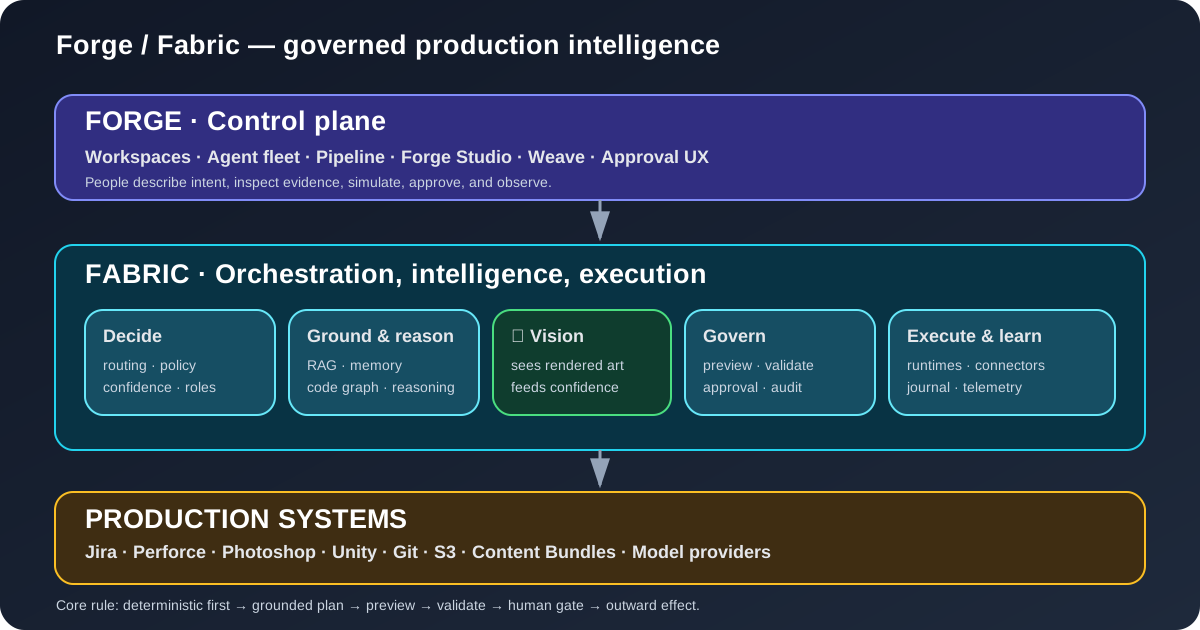
Forge lets people describe, inspect, approve and observe production work; Fabric turns that intent into a grounded, policy-gated plan and executes it through real workstation tools and external systems.
Game production is full of repetitive, multi-tool, error-prone work — pull art from Perforce, run Photoshop, wire sprites in Unity, set up data, package offers, validate, commit, update Jira.
Runs that work autonomously and provably — grounding every value in a real source, validating the result, and holding for a human sign-off before any outward effect.
The speed of automation with the accountability of a reviewed change: deterministic, auditable, human-gated — local-first, cloud-capable.
Two parts, one platform
The browser product: workspaces, Pipeline, the agent fleet, Mission Control, approvals, health, Forge Studio and Weave — the screen-aware assistant. Where people describe, approve and observe. It never executes tools directly.
The engine beneath: grounds, reasons, decides, executes through the right runtime and connectors, and records evidence. Replaceable without changing Forge.
The stable contract between them is agent JSON — the single, reviewable source of truth. That boundary lets the product evolve without destabilizing production execution.
Outcomes
A ticket that took ~a day of hand-work runs in under 30 seconds — grounded and streamed live.
100% audited runs, deterministic-first, human-gated outward effects, and full provenance on every value.
Each new production domain becomes a new agent on the same runtime — not a new tool to build and maintain.
How it works
Every run follows the same governed arc: ground the request, reason over real knowledge, plan and execute through the right runtime, validate, hold for human approval, then record and learn. See the full walkthrough in Pipelines and the layered design in Architecture.
Status
Learn more
What · why · how
Why: one surface for intent, evidence, approvals and progress.
Use through the local server; select workspace, agent, ticket and run mode.Why: central HTTP, security and side-effect boundary.
Routes API calls, streams runs and hosts the generic runtime.Why: prevent cross-team agent and learning-context bleed.
Scopes storage from the request's workspace header.Why: behavior must be reviewable, visual and versionable.
Validate and persist losslessly compiled agent JSON.Why: make routing, authority, values and evidence explicit.
Compile sources into a typed plan before execution.Why: reason from real production context without hard model dependencies.
Request a capability lane (local or cloud); retrieve workspace-scoped evidence (local JSONL or hybrid pgvector).Why: pixels and readiness need specialized evaluation.
Review visual evidence and certificates before production.Why: improve from observed outcomes, not intuition.
Capture best-effort signals after calls and runs.Why: unsupported AUTO work must fail before mutation.
Maps capability, mode, writes, role and rollback.Why: art, zero-touch Unity, Offer/DD fan-out and character data need distinct engines.
The agent'sruntime field selects generic · unity · offer · data.Why: Photoshop and Unity own specialized project state.
Readiness-check, execute controlled actions and capture results.Why: external failures need consistent retry and health semantics.
Wrap safe idempotent calls and record latency/outcome.Why: irreversible effects require explicit authority.
Viewer → operator → deployer → master.Why: constrain destinations and blast radius.
Audit branches, paths, failures and rollback posture.Why: a crash must not erase evidence of partial work.
Persist lifecycle and expose orphaned runs once.Why: answer "is this character production-ready, and what's missing?" from evidence.
Read-only deterministic diff of required artifacts vs observed state; unknowns stay unknown.Trust and recovery
p4 submit source art from Forge.Visual reference
Open any diagram for a full-size view. Use the arrow keys to move through the collection.