Node palette (left)
The capabilities you can add — Observe, Source, Transform, Validate, Decide, Approval, Publish and domain nodes — dynamically reflecting what the current runtime supports.
Forge Studio is the visual composer where production experts design, inspect, test and publish agents in domain language — no hand-editing JSON. Studio is not a runtime: it converts agent JSON to a graph and back losslessly, and preserves fields it cannot draw.
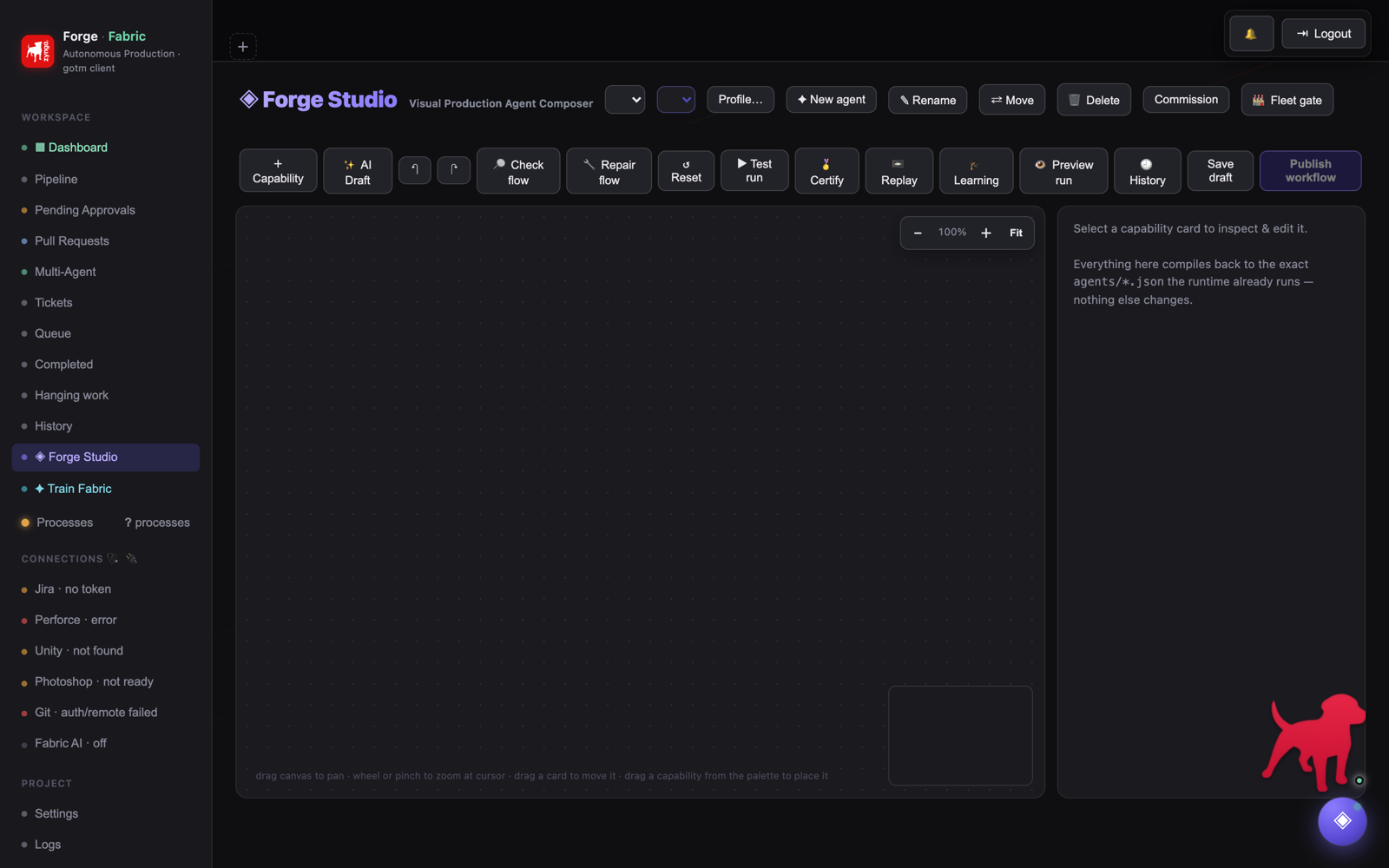
Layout
The capabilities you can add — Observe, Source, Transform, Validate, Decide, Approval, Publish and domain nodes — dynamically reflecting what the current runtime supports.
The agent as a graph: drag to add, connect stages, insert or delete nodes, and repair a broken flow. The spine shows execution order.
Per-node configuration: label, type, execution mode, inputs/outputs, policies, validators and evidence — tabbed and contract-aware.
Modes
A human performs the step; Forge records it and hands off honestly. Used where no safe automated executor exists yet.
Fabric performs the step through a real capability (vision QA, grounded drafting, reasoning), always grounded and confidence-scored.
A deterministic executor runs the step (Photoshop JSX, Unity bridge, Perforce sync, data write) — only if the executor registry supports its mode and runtime.
AI is the default execution mode wherever a genuine capability exists — but it never fabricates success and never replaces the human approval gate. A step with no safe executor is an honest manual hand-off, not a faked “done”.
Workflow
Agent Fabricator turns a ticket or plain-language goal into a grounded candidate graph with typed contracts, capability bindings and review evidence. You review the proposal; Fabric never auto-publishes it.
Set each node’s type, execution mode and config; wire the spine. A flow-break check catches disconnected or invalid graphs.
Structural lint plus a Harness simulation produces an explainable readiness result before anything runs for real.
Publishing makes the definition live; it does not execute it. Versions provide history, visual diff and rollback.
Teach by demonstration
Learning Studio and Forge Studio are two stages of one governed workflow. Learning Studio retains what a person demonstrated and grades the evidence as exact provider-verified, typed provider-observed, visual-observed, context-only or unobserved. Recording may continue when one source degrades, but Forge Studio receives only the supported semantic procedure; unsupported steps stay explicit and replay-blocked.
Open the recording library by task, status or date. The signed Task Workspace keeps the original observations, human semantic revisions and include/exclude decisions immutable and reloadable.
Context and separately consented visual evidence can explain chronology, but cannot invent a layer ID, property, path or numeric value. Learning Studio binds eligible exact actions and sends unresolved implementation gaps to Toolsmith; evidence gaps request recapture instead of creating fake tools.
After every included step is resolved, an administrator may register the exact content-addressed Skill Graph candidate in Forge Studio. Caller-supplied graph substitutions and unresolved demonstrations are rejected.
Server-owned sandbox preparation re-reads the signed workspace, binds the plan, rejects protected targets and validates without writes. Then configure authoritative inputs and validators and use Check → Test → Resolve → Certify → Save → Publish → Commission. A prepared plan still needs authoritative disposable-sandbox attestation, separate live consent, qualification and release evidence.
The reusable asset is the typed semantic procedure plus exact capability bindings, evidence references and validators—not raw video or recorded coordinates. Only exact provider-verified operations can progress toward deterministic replay; provider-observed, visual and context evidence remain review material. When an action lacks a stable object, exact arguments, native proof or a governed provider, Studio shows it as unresolved/manual rather than claiming it can replay the step.
The repository contains native integrity protocols, detailed supported Photoshop/Unity capture, consented encrypted visual fallback, cross-app contract/source seams and bounded reanalysis/preparation services. Installed signed Photoshop and cross-app native products, trusted keys/manifests, notarization, authoritative sandbox attestation, the real 20-case corpus, independent review, production qualification and commissioning are still required outside Studio.
See Learning Studio for the capture and review boundary.
Trust
Preview verifies capability-to-executor coverage and shows proposed reads and writes. Simulation runs the Harness checks and produces a readiness certificate with a confidence meter. A high score never makes an unsupported or outward action safe — executor, policy, validation and approval gates remain binding, and the Harness is advisory to the approval gate, never a hidden blocker. Golden baselines let you catch regressions (▲/▼) against a known-good certification.
Beyond the readiness certificate: golden baselines + regression, security checks (secrets, shell-safety), replay (predicted vs actual), contract coverage + the AUTO-executor gate, and the Fleet Quality Gate — a studio-wide, weakest-first roll-up that certifies the whole roster before any run is trusted.
Intelligence Profiles v1.2.0 prove an agent's readiness across workspaces — resolved capabilities, installed/enabled knowledge, sealed runtime skill manifests, and required-tool readiness. Skills (48 from .claude/skills) follow a knowledge-vs-executable contract: RAG-ready guidance immediately, execution bound and sealed by version + digest at run start — no silent drift.
Reuse & recovery
Start new agents from templates; reuse proven node groups as components. Treat a component like shared production code — narrow contracts, versioned changes, retest every consumer.
Draft → Published with a visual diff and rollback, so a change is reviewable and reversible.
Flow breaks (use Repair flow), unsupported AUTO stages (pick a supported mode/executor), low source coverage (add grounding sources).
Inspect its stated missing requirement or capability gap. Fabric retries malformed model output through governed planning and deterministic compilation, but it will not invent a tool or claim an unsupported node is executable. Check model health, provide authoritative inputs, or bind a qualified capability.
Modernizes a legacy agent as a preview: preserves authored behavior, proposes typed capabilities and executor bindings, and exposes every unresolved physical stage. Apply to canvas remains undoable and does not save, publish, commission or run the agent.
Upgrade, Check, Test and Certify each agent, then complete a supervised production pilot with retained destination and outcome evidence. Keep the legacy runtime available until every dependent agent has passed that sequence; migration is per agent, never a bulk trust assumption.
Federation
Publishing a callable agent lets other workspaces import a governed, credential-safe copy that stays pinned to the exact source version it was taken from. When the source owner changes a shared dependency, Studio does not silently mutate those copies — it helps the owner drive every affected copy through one sealed migration campaign, so a fleet-wide upgrade stays reviewable, evidence-bound and reversible.
The copies impacted by one dependency change are grouped into a single durable campaign bound to that exact impact set. Each draft moves forward through prepared → reviewing → certified → published (failed is an off-path terminal), every transition appends immutable evidence, and a completion roll-up reports the campaign as in-progress, needs-attention or complete.
If the upgrade changes the dependency's input/output contract, the upgrade is blocked until you map the boundary. Remap-preview auto-maps same-name, same-type fields and lists exactly which inputs and outputs still need an explicit mapping or default; the reviewed plan is digest-bound and travels with the draft.
A draft only reaches certified when the real Harness certifies that agent — Studio never trusts a caller-supplied state for that step. Manual advances are limited to reviewing or failed; certified and published are written by governed gates and the publish path.
Consumers of a changed dependency receive retryable cross-workspace notices tracked in a durable delivery ledger: pending → delivered, or failed with bounded retry and dead-lettering after five attempts. Reconciliation re-attempts every outstanding notice, so a transient outage never drops a consumer.
The Agent Store is a searchable catalog of commissioned, available and decommissioned agents — showing origin, execution model, capabilities, contracts, success rate and certification. Export a checksum-sealed forge.agent-package.v1 bundle (portable graph, profile metadata, permitted local skills; credential-shaped fields stripped). Preview is a bounded read; installation is a separate admin-gated action that never grants credentials, tool access or commissioning authority.
Agents created or materially upgraded by Fabric carry the FABRIC origin treatment, with Harness-bound certification shown separately. The guided lifecycle — Build → Check → Test → Resolve → Certify → Save → Publish → Commission — keeps uncommissioned pilots preview-only, with no real production writes until commissioned.